


Actually, please sue us. We’re begging.
We are selling merchandise featuring the official seal of the City of Santa Clarita. T-shirts. Coffee mugs. Stickers. Tote bags. Whatever we can get a heat press near.
You can find the merch here. Every item you buy is a small act of civic defiance, a stylish conversation starter, and a financial contribution to what might become a genuinely interesting trademark case.
Or it’s just a coffee mug. That also rules.
Why Is This a Thing?
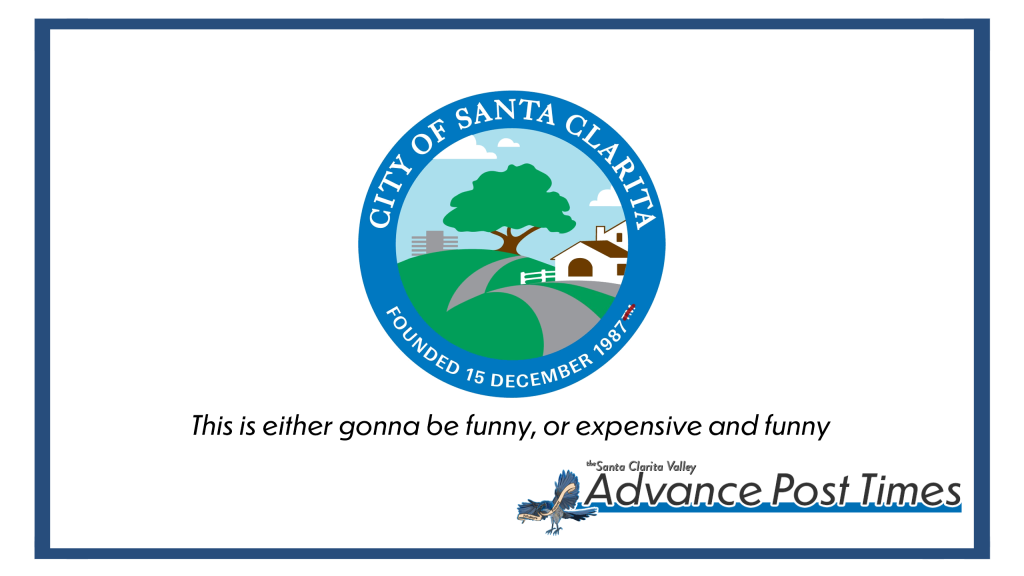
There’s a little secret the City of Santa Clarita doesn’t want you thinking too hard about: they claim to own the city seal. Our city seal. The one that belongs to every resident of this valley, paid for with public money, representing a public government — and they’ve filed trademark paperwork on it like it’s a logo for an energy drink.
We know. We were surprised too. We’ve had some time to process it.
So we’re selling it on merch, and we would like — sincerely, genuinely, with our whole chest — for the City to sue us about it.
Here’s the Part Where We Explain the Law
(We know, we know. Bear with us. There’s a punchline.)
In 2013, the United States Court of Appeals for the Federal Circuit ruled, in In re City of Houston, that municipalities cannot register their official seals as federal trademarks. Full stop. The Lanham Act — the federal trademark statute, named after a Texas congressman, used to defeat a Texas city, which is the kind of irony they don’t teach you in law school because law school doesn’t have a sense of humor — explicitly bars registration of “the flag or coat of arms or other insignia of the United States, or of any State or municipality.” 15 U.S.C. § 1052(b).
Houston tried to argue that the law was meant to stop other people from misusing the seal, not to stop Houston from registering its own. The Federal Circuit said: no. The law means what it says. A city seal is an insignia of government authority. It’s not a brand. It doesn’t get trademark protection.
The City of Houston spent money on lawyers to make this argument.
They lost.
Here’s the punchline: Santa Clarita filed for the trademark on May 6th, 2008 — five years before the Federal Circuit made clear this was impermissible. So fine, they get partial credit for not knowing at the time. But they’ve known for over a decade now. The trademark is still on the books. Nobody has ever challenged it. It will be old enough to vote this year, which feels appropriate for a symbol of democracy that nobody is allowed to use.
We have decided that “nobody” is going to be us.
Oh, And There’s Also a Municipal Code
Here’s something we found while doing our homework: the City of Santa Clarita already had a perfectly functional legal mechanism to control use of its seal before it ever filed a trademark. Municipal Code Section 1.04.030, adopted on December 15, 1987 — the same day the city incorporated — gives the City Manager sole discretion over who may use the seal and under what conditions. Unauthorized use is declared a public nuisance. The city can abate or enjoin it.
So to recap: the city had a law on the books in 1987. They filed a trademark in 2008. The trademark was rendered legally dubious by a federal court ruling in 2013. The law from 1987 is still there. The trademark is also still there. Nobody has asked why.
The municipal code also contains this phrase, which we would like to highlight: “Except where authorized by federal law.” Their own code acknowledges that federal law can override their restrictions. The Lanham Act is federal law. We are just pointing this out.
Additionally, Section 1.04.030(G) states that unauthorized use of the city seal “is declared a public nuisance.” We would like to note that we have read this provision carefully and remain unbothered — not because we’re reckless, but because there’s a meaningful legal distinction between what the ordinance can reach and what it can’t.
Municipal ordinances cannot override federal law, and the First Amendment is federal law. Using a government seal for political commentary, civic criticism, or satire is almost certainly protected expression. Courts have consistently held that using government insignia in a communicative context — as opposed to impersonating the government — is protected speech. Our merch is explicitly political commentary on the city’s dubious trademark claim, which puts it squarely in that protected zone. The ordinance might have teeth against someone printing the seal on t-shirts purely for profit with no expressive content. It has considerably less to say about a satirical news organization selling merch to fund a legal challenge to that very ordinance.
This is, incidentally, also why the trademark matters more than the municipal code as an enforcement tool — federal trademark claims carry real remedies including damages, whereas a nuisance abatement under local ordinance is a much weaker instrument. The city’s strongest legal weapon is the one that a federal court has already said shouldn’t exist. We find this amusing.
One unelected city official — the City Manager — has sole discretion over who gets to use the symbol of your government. We thought you should know that.
Why Does This Matter?
Because trademark claims have teeth, even bad ones. A city can use a dubious trademark registration to threaten small businesses, artists, satirists, and journalists with cease-and-desist letters. Most people — rationally, sensibly — back down when a city government’s lawyer sends them a letter. They don’t have time for a lawsuit. They don’t have money for a lawyer. The threat alone does the work.
That’s not how this is supposed to work. Government seals are not intellectual property. They are symbols of public authority, and the public — that’s you, hi — has every right to use them, display them, and yes, print them on a tote bag and bring them to the farmer’s market.
The only way to establish that right firmly enough that the city can’t use the trademark as a threat anymore is to make them try to use it as a threat in front of a federal judge.
So that’s the plan. It’s a simple plan. We like it. We’d also like to not do it. We have other things going on. But here we are.
Where Your Money Goes
Proceeds from the merch will go toward:
- Legal defense costs if (when?) the City decides they’d like to explain to a federal court why their trademark is valid
- Covering the cost of more merch, because if this works, we’re going to keep going
- Funding continued coverage of the local government that loves to spend your money on things that aren’t your problem to fix
There’s an Easy Way Out, Santa Clarita
We’re not unreasonable people. We contain multitudes. Some of us compost.
If the City opts to simply drop the trademark rather than litigate it, we’ll make them a deal: donate whatever would have been spent on lawyers to Bridge to Home, the SCV’s primary unhoused services provider, and to the Fernandeño Tataviam Band of Mission Indians — the indigenous people of the Santa Clarita Valley, whose ancestral territory the city’s seal represents and whose land the city was incorporated on in 1987, the same year it adopted that seal — and we’ll donate our merch profits to both as well.
We note, with no particular emphasis, that the Fernandeño Tataviam are not federally recognized, which means the United States government does not formally acknowledge their sovereignty over the land they have occupied since time immemorial. The City of Santa Clarita, meanwhile, has a federal trademark on its logo. We’ll let that sit there.
We’ll also throw in a freebie: a proposed amendment to Municipal Code Section 1.04.030 that actually makes sense. The current code gives the City Manager unchecked discretion to permit or deny any use of the city seal for any reason, which is both overbroad and unaccountable. A sensible amendment would narrow the prohibition to uses that are actually harmful — specifically, uses that falsely imply the City’s endorsement of a product, event, or candidate without consent. That’s the thing worth protecting against. It’s also, notably, already covered by existing state and federal laws against false endorsement and unfair business practices, so the city council would essentially be passing a law to feel better about a problem that is already illegal.
But fine. If the council needs to feel special and protective of their precious city seal, we support a narrowly tailored ordinance that prohibits deceptive commercial use while explicitly carving out political speech, satire, journalism, and commentary. You know — the things the First Amendment exists to protect. Consider this our gift.
Everyone wins. The unhoused get funded. The Tataviam get acknowledged. The trademark gets killed. The municipal code gets cleaned up. We don’t have to find parking near a federal courthouse. The City gets to avoid the embarrassing spectacle of arguing before a federal judge that they own a symbol of public government.
The ball is in your court, City Hall. It’s a very easy ball to return.
If You’re a Lawyer
We’re not idiots — we know there’s nuance here. State trademark registrations operate differently from federal ones. There’s some ambiguity around unofficial logos versus official seals. We know.
If you’re an IP attorney who thinks this is interesting (or thinks we’re about to step in something), we’d genuinely love to hear from you. Drop us a line at legallydubious@scvapt.com. We are open to the possibility that we’ve missed something, and we’d rather know before a process server shows up at the door wearing the city seal on a t-shirt. Ironically.
But we’ve read In re City of Houston, 731 F.3d 1326, and we feel pretty good about where we’re standing.
Share This
This only works if people know it’s happening. Share this post. Tell your neighbors. Tell your city council rep. Forward it to that one guy in your HOA who has opinions about everything — he’ll love this.
A brief note to City Hall: you are, right now, in possession of a golden opportunity to let this quietly die. The alternative is suing a local satire website over a coffee mug, which will introduce the phrase “Santa Clarita trademark lawsuit” to every IP law blog, local news outlet, and First Amendment Slack channel in the country. You may have heard of the Streisand Effect — the phenomenon where attempting to suppress something makes it dramatically more visible. It is named after a celebrity who sued to remove a photo of her house from the internet, thereby ensuring that everyone on the internet saw a photo of her house. We are, in a very real sense, offering you the chance to not be Barbara Streisand right now.
If the City wants to litigate our right to put the seal of our own government on a tote bag, we want the whole valley watching.
We Have Not Heard From Any Lawyers (yet)
As of April 1st, 2026 at 10:12am, the Santa Clarita Valley Advance Post Times has not received any cease and desist letter, legal notice, court filing, or other communication from the City of Santa Clarita, its attorneys, its City Manager, its City Clerk, or any other party seeking to restrict, compel, or otherwise interfere with our coverage of this matter or the sale of the merchandise described herein.
This section will be removed if that changes. Its continued presence in this post should be understood as confirmation that we remain free to publish, sell, and discuss everything described above.


Samuel Horwitz is a Santa Clarita native and the younger brother of SCVAPT contributor Jerome Horwitz, though he will remind you that he is technically the one in charge. His family traces their lineage all the way back to the 1960s, when his grandparents moved to the area to start a farm in what is now Castaic Lake. Growing turnips proved unfeasible below water, so they got out of farming and started a donut shop specializing in Bear Claws.
Samuel has been described by colleagues as “bossy” and “somehow always right about everything, which makes it worse.” In his spare time he enjoys local government meetings and a recurring physical comedy bit with Jerome that HR has been asked to look into.
Samuel holds no formal journalism credentials, which he considers a point of pride and shares with the rest of the SCVAPT masthead.


